
This guide has been verified by our Engineering Compliance Team to align with current OSHA 1910.179 and ASME B30.2 standards. It was last reviewed for technical accuracy on January 2, 2020.
Previous Blog: What are the Parts of a Crane?
3 Ways to Save Money on Energy Efficiency in Buildings with Cranes
To help you rise above the competition, we look for ways that our products can maximize reachable floorspace and help you realize energy savings. It’s not enough to deliver on expectations—we search for innovative adjustments that can save you time and reduce energy costs over the life of your cranes.
When designing your next build, ensure energy efficiency by keeping this in mind: don’t construct space you won’t need. Design the building to the specifications of your crane to remove additional overhead space that will need to be heated, cooled and lit.
When it comes to cranes, three design factors will impact the energy efficiency of your building:
• End approach
• Headroom
• Equipment size
To save on overall energy costs, shrink your building envelope by optimizing headroom and end approach and right-sizing your equipment for energy consumption. The bigger the building, the more it’s going to cost to heat, cool and light the extra space above the girder. Consider the following for your next build to create optimal energy efficiency.
End Approach
A good end approach can help optimize the size of your building and avoid unused space. End approach measures how close the hook can get to the end of the crane’s runway, and the closer the hook can get to the wall, the more floorspace you can reach in your building. This minimizes wasted space potential that could otherwise be put to efficient use.
Headroom
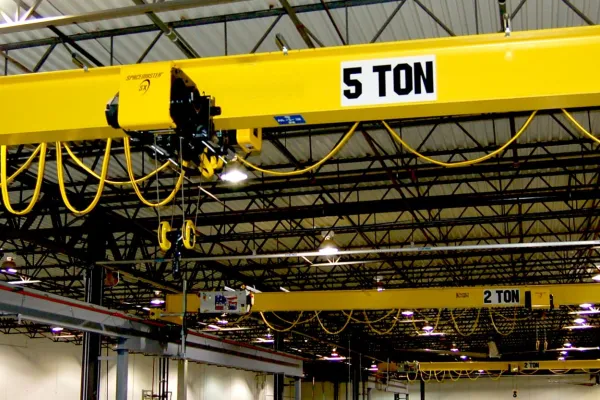
Headroom (referred to as C dimension on our mechanical drawings) determines how high you can get the hook relative to the runway rail. It’s important that your crane can achieve the required lift height for your application without creating extra, unusable space above the girder. Our hoists have some of the best headroom capabilities in the industry, and our compact design means the crane is nested into the ceiling more efficiently. This allows you to build a smaller building, preventing unnecessary heating, cooling[1] and lighting expenses.
Equipment Size
Another way to save on energy costs over time is to consider the consumption of electrical current by your machinery. For example, we make sure that the power supply, inverter controls and motors work as a complete system and are right-sized to prevent unnecessary energy consumption. Instead of a third-party runway conductor bar that may be overpowered, a right-sized drive train requires less energy over its lifecycle, and all the components before the motor, such as the runway conductor bars, festoon and inverter, can be a smaller size, requiring less energy and less up-front costs. This can save on the energy consumption of your equipment and your total cost of ownership.
Working in tandem, these three factors can reduce the energy costs of your building. You can see an illustration of how headroom and end approach can save space in new construction in our Spacemaster® SX brochure.
Heat, cool and light only the space you need with a well-designed building for your operations. To learn more about R&M products for your next build, or to find an R&M distributor near you, contact us.
At R&M Materials Handling, Inc., our content is created to support end users and distributors with practical insights rooted in real-world applications. Each article is developed by the R&M Materials Handling team and shaped by the expertise of our engineers, product specialists and customer support professionals. Our goal is to answer common industry questions, share best practices and help readers get the most out of their lifting and materials handling systems.
Related Resources
Explore external resources and studies that provide additional insights on lifting safety and equipment.