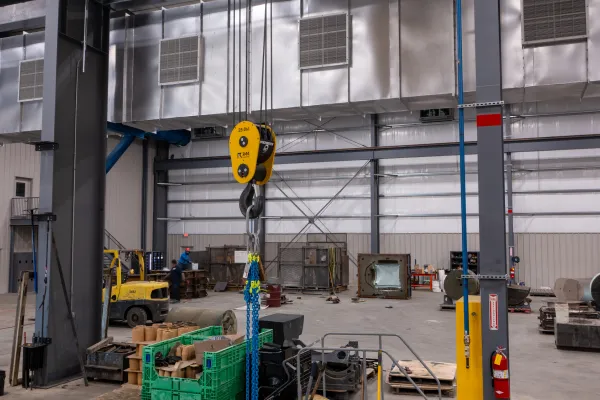
The hoist is a critical part of a lifting system, so choosing the right one for your application is one of the most important decisions you’ll make. Choosing the right lifting equipment starts with understanding the application and its requirements. We understand that choosing a hoist involves more than cost; safety, efficiency and durability also play a role.

Hoist selection starts with the application’s required capacity and lift height. Duty cycle and suitability for the operating environment help determine the hoist’s service life, so the equipment should be specified for its expected workload and site conditions.

Hoist Selection & Sizing

The first step in hoist selection is defining the needed capacity. The maximum lifted weight should include the load itself, fixtures, below-the-hook devices, rigging and any other equipment being lifted. Operators should never lift a load that exceeds the rated capacity shown on the hoist nameplate. Load testing as defined in the equipment manual is allowed at 125% of the rated load. The Occupational Health and Safety Administration (OSHA) defines rated load as the maximum load for which the crane or individual hoist is designed and built by the manufacturer and shown on the equipment nameplate.

Next, determine lift height, speed requirements, control type and duty cycle. If operators need accurate positioning near machinery, variable speed lifting can offer more precise control and access to extended operator assist features. If throughput is the primary concern, selecting an appropriate lift speed and higher duty cycle rating helps ensure performance throughout the safe working period of the hoist.

The facility's environment will also play a role in hoist selection. Temperature, humidity, dust, corrosive environments, outdoor use, chemical vapors and hazardous location requirements can change the recommended hoist, motor, brake, enclosure, controls and finishes.

Key sizing questions include:

  • What is the heaviest load your application may encounter?
  • How often is it lifted?
  • How many shifts per day will the hoist operate?
  • At what height and what speed will the load be moved?
  • If the building is existing, what are the dimensions of the available space?
  • What environmental conditions will the hoist operate in?
  • What codes, plant standards or customer specifications apply?
  • Will the hoist be integrated into a system with other motions, such as a monorail or bridge crane?


Show

Hoist Duty Classifications & Duty Cycles

Hoist duty classifications, defined by ASME and ISO, describe how hard a hoist is expected to work. Capacity alone does not define the right hoist. For example, a hoist lifting near capacity once a week has a very different duty requirement than a hoist being used daily at half capacity or less.

Selecting the appropriate duty classification helps account for expected loading and operating conditions and can help reduce premature component wear. Over-specifying may increase cost unnecessarily, while under-specifying can lead to overheating, downtime and shortened component life.

Duty cycle considers factors such as average load, number of lifts, lift height, motor starts, running time, work periods and service severity. Light service applications typically involve infrequent lifts at partial capacity. Heavy-duty applications often involve frequent lifts and lifts utilizing a high percentage of rated capacity.

When an existing hoist has a condition monitoring device, start with its historical operating data. Recorded loads, lifting cycles and running time help establish how the equipment has actually been used, providing a stronger starting point than estimates alone for determining the duty cycle of future equipment upgrades or replacements.

For a new facility or equipment without monitoring data, calculate duty requirements using the expected workload. First, identify the load spectrum, which describes the mix of loads handled relative to rated capacity. Then calculate daily operating time using average lift height, lifting cycles per hour, daily working hours and hoisting speed.

With this information, we can use load spectrum charts, operating-time formula and classification table to determine the appropriate hoist duty cycle for the application. R&M or an authorized distributor can help review the result and compare the applicable ISO, FEM and ASME duty requirements.

Show

Safety Standards & Compliance

Hoist safety depends on trained operators, compliant equipment and consistent procedures. Overhead lifting systems are commonly regulated by OSHA regulations, applicable American Society of Mechanical Engineers (ASME) standards, manufacturer instructions and site-specific safety policies.

A practical safety program includes pre-use checks, documented inspections, preventive maintenance, operator training, lockout-tagout procedures, required load testing and review of modifications before return to service. Because requirements vary by jurisdiction and application, always confirm them with qualified safety, engineering and compliance personnel.

Show

Maintenance, Inspection & Troubleshooting

Detecting and addressing potential issues early through preventative maintenance can help reduce unplanned downtime and support safe operation.

Daily or pre-shift checks are typically performed by operators and focus on visible and functional conditions, such as unusual noises, damaged hooks, missing safety latches, chain or rope condition, pendant operation and limit switch function. Regular inspections (quarterly, biannually or annually) are performed by crane service technicians who review things like rope wear, sheave condition, drum wear, bearing conditions, contactor life, brake wear and gearbox lubrication.

When hoist maintenance questions arise, remove suspected unsafe equipment from service and contact a qualified crane service provider.

Show

Hoist Types & Configurations

Electric chain hoists are compact, efficient and widely used for lower capacity applications, workstation cranes, jib cranes, monorails and production cells. They are well suited for repetitive lifts with limited headroom.

Rope hoists (wire or synthetic) are commonly used for higher capacities, longer lifts, faster speeds and heavier-duty crane systems. They may be configured as normal headroom, low headroom, foot mount or double girder arrangements depending on the application needs.

Manual chain hoists provide an economical option for lower-capacity lifting applications. They are commonly used for maintenance, occasional lifts, equipment positioning and areas where simple operation, portability or limited access to electrical power are important. Available configurations include hook mounted hoists, hand geared or push trolleys and lever pullers.

Crane packages include all of the crane components required to assemble a complete crane, including a hoist and trolley, end trucks, bridge panel, festoon, bridge drives and pushbutton pendant or radio control. Cranes can be configured as single or double girder and top running or underrunning. The right configuration depends on the area covered, load capacity, building structure, operator needs and production workflow.

Show

Key Parts & Components of a Hoist

Hoists include a variety of mechanisms to allow them to lift and lower loads. Regular maintenance and repair is an important part of ensuring the longevity of your hoisting equipment. Replacement parts should match the hoist serial number. Using incorrect or non-OEM parts can affect performance, warranty and safety.

Show

Industry Applications

Hoists support maintenance, production, assembly, material staging, equipment changeovers and specialized lifting tasks across a wide range of industries.

Typical applications can include:

  • Automotive: Moving or turning dies, tooling, fixtures, vehicle components and production equipment during assembly, maintenance and line changeovers for manufacturing facilities and satellite supply chain or feeder plants for sub-assemblies
  • Petroleum and gas: Handling pumps, valves, compressors, piping components and other equipment during maintenance and process operations, including applications that may require hazardous location-rated equipment
  • General manufacturing: Supporting assembly, machining, maintenance, material transfer and repetitive production tasks involving components, fixtures and equipment
  • Power plants: Moving motors, pumps, turbines, valves and other heavy components during installation, inspection, maintenance and outage work
  • Metal production and fabrication: Handling raw material, fabricated parts, dies, molds, plate, structural components and finished assemblies throughout production
  • Textiles: Moving rolls, machinery components, production equipment and materials during manufacturing, maintenance and equipment changeovers
  • Mining: Supporting maintenance and equipment handling for motors, pumps, crushers, conveyors and other heavy components used in demanding operating environments
  • Food processing: Handling production equipment, machinery components and materials in applications where cleanliness, corrosion resistance and environmental conditions may affect equipment selection

Across every industry, the goal is to match the hoist and crane configuration to the load, operating environment, duty requirements and workflow so material can be moved safely and efficiently.

Show

Technical Resources & Standards

Important standards and reference areas include OSHA 1910.179 and OSHA 1926.1438 requirements for overhead and gantry cranes. ASME standards cover the safe design, construction, testing and operation of mechanical equipment. ASME B30.16 covers overhead underhung and stationary hoists, including hand chain-operated, electric-powered and air-powered chain and rope hoists. ASME B30.2 applies to top running trolley hoists, gantry and semi-gantry crane configurations and top running single or double girder bridge cranes used for vertical lifting and lowering of freely suspended loads. Additional standards include ASME B30.10 for hooks and ASME B30.17 for cranes and monorails with underhung trolley or bridge. Always verify the current edition and applicability before making engineering or compliance decisions.

Show

Quick Reference for Key Hoist Concepts

For more hoist and crane terminology, visit our overhead material handling glossary.

Capacity: The maximum rated load shown on the hoist or crane nameplate. Example: 5 ton (5000 kg) capacity.

Lift: The vertical distance the hook must travel from the lowest pickup point or floor to the highest possible position of the hook. Example: 20 ft (6 m) of lift.

Headroom: The space required from the suspension point or beam to the hook. Low headroom designs help maximize usable lift. Example: 24 in. (610 mm) of headroom.

Duty Cycle: How often and how intensely the hoist operates, including starts, run time, load percentage and service conditions. Example: ASME H4 duty classification.

Hook Approach: How close the hook can get to the end of a bridge, runway or trolley travel path. Example: 18 in. (457 mm) hook approach.

Trolley: The wheeled unit that carries the hoist along the beam or bridge girder.

Bridge Crane: An overhead crane that travels on runways, allowing the hoist and trolley to cover a rectangular work area.

Monorail: A fixed beam that allows a hoist and trolley to move along a defined route.

Below-the-Hook Device: A lifting attachment such as a spreader beam, magnet, vacuum lifter, clamp or custom fixture used between the hook and load.

Overload Protection: A device or system intended to help prevent lifting beyond rated capacity.

Limit Switch: A device that stops or limits motion at a defined travel point.

Not sure what you need for your application? Contact us to speak with an expert or use our Crane Designer to find the right size and features for your overhead lifting system.

Show