
Date: 2/13/2026
Previous Blog: Crane Safety And Inspection Protocols
Leveraging IoT for Connected, Predictive Hoist Systems
The industrial lifting sector is undergoing a digital revolution, with hoists emerging as key assets with connected and smart features in manufacturing, warehousing and industrial facilities. Modern hoists are evolving into intelligent systems through IoT integration, creating interconnected networks that bridge physical equipment with digital analytics platforms.
By integrating sensors, cloud analytics and operator assist features, modern hoist systems can transition from isolated mechanical devices to intelligent nodes within a connected lifting equipment ecosystem. R&M Materials Handling embraces this transformation through hardware innovations like the HoistMonitor® Enclave and ControlMaster® inverter controls, working with OLI Comms fieldbus hardware and OLI software solutions, which empower organizations to optimize safety, productivity and maintenance workflows.
The Internet of Things (IoT) refers to a network of interconnected physical devices that collect and share data over the internet, facilitating smarter interactions and automation in various applications. It includes a wide range of physical objects—ranging from everyday household items to complex industrial machinery—that are equipped with sensors, software and connectivity features. This enables these devices to gather and exchange data, communicate with one another and perform tasks with automated safety functions.
Below we will explore technical innovations and practical benefits driving this digital revolution, beginning with three core connectivity advancements.
1. Sensor-Driven Data Collection
IoT hoists use integrated sensors and monitoring devices to track parameters like current load weight, equipment usage and cycle counts. For example, R&M’s HoistMonitor Enclave device monitors overloads and predicts usage-based service needs. The gateway modem sends this data to the cloud with timestamps to give equipment owners a holistic view of their equipment usage.
2. Cloud-Based Data Aggregation
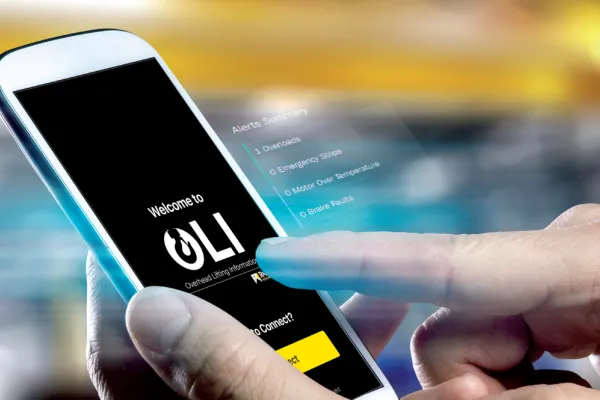
Data from sensor-enabled hoists is transmitted via IoT gateway to cloud platforms, where it’s processed and made accessible through interfaces like R&M’s Overhead Lifting Information (OLI) app. With the OLI app, technicians can connect to the equipment onsite via WiFi and retrieve real-time data. This eliminates the need for manual data retrieval via the HoistMonitor Enclave's keypad and provides visibility for everyone on the job site.
With OLI Pro, crane service providers can access remote data that can then be used to create a predictive maintenance schedule for critical components such as wire ropes and brakes, rather than experiencing surprise downtime due to unexpected repairs.
3. Onsite Data Accessibility
The ControlMaster Edge inverter integrates hoist, trolley and bridge inverter controls into a unified interface, enabling precise control and compatibility with diagnostic tools. TD Drive Tool app enables the connection of smart devices to the inverter hardware through an electronic key.
When combined with a complete OLI Comms+ fieldbus crane system, the ControlMaster Edge inverter is compatible with the OLI app – allowing users to pull necessary data across the whole crane system.
Real-Time Safety Monitoring and Analytics
IoT solutions transform raw operational data into actionable insights through three key mechanisms:
1. Operational Transparency
The OLI app provides wireless access to metrics such as:
- Average and maximum hoist loads
- Cycle counts
- Active fault codes
- Service warnings
Facility managers can monitor these metrics from the factory floor without halting production, as demonstrated in deployments at Hoosier Crane Service Company.
“As tech takes its place in our industry, we can expect to see more wireless capabilities. No more shutting a crane down to take care of data checks.”
--Todd Cook, COO at Hoosier Crane Service Company
2. Condition-Based Alerts
The HoistMonitor Enclave gives alarms for faults and service warnings, such as:
- Overload events
- Brake wear
- Motor overheating
These alerts enable immediate corrective actions for faults and prevention of future downtime with service warnings. Together, they keep minor issues from escalating into failures.
3. Designed Working Period Percentage (DWP%) Tracking
R&M’s system calculates the DWP% for critical components, such as brakes, contactors and even the hoist itself, counting down from 100% based on actual usage. This metric predicts the remaining service life, with automated warnings at predefined thresholds. As wear items such as brakes and contactors are replaced, technicians can reset parameters to reflect service work that's been done.
Predictive Maintenance Advantages: From Calendar-Based to Condition-Driven
The shift from traditional, calendar-based maintenance to predictive, condition-based strategies is one of the most significant benefits of IoT integration. With continuous data collection and sophisticated analytics, R&M’s systems can help identify the most appropriate inspection schedule for critical components such as wire ropes, brakes and bearings. This predictive approach is enabled by algorithms that analyze usage patterns to estimate the remaining useful life of the equipment.
Hoists equipped with IoT-enabled hardware support predictive maintenance, shifting from reactive to proactive maintenance strategies.
Resource Optimization
Maintenance schedules can align with actual equipment usage rather than fixed intervals. Operators can schedule maintenance to maximize the performance of their equipment and minimize unexpected downtime, reducing the total cost of ownership (TCO).
Downtime Reduction
Simplifying root-cause analyses, cloud-based fault logs through OLI Pro+ take data and add a timestamp to it. Rather than the technician seeing a fault log, which is useful, they see a fault log with time attached to the faults. It's useful to know that there have been 10 overloads, but even more useful to know that these 10 overloads occurred during a specific operation timeframe.
OLI Pro+ indicates not just the fault but how the hoist is being used. That helps crane service companies identify key maintenance activities and training needs and can reduce downtime.
Smarter, Safer, Connected Lifting: IoT as a Safety Multiplier
IoT hoists and connected lifting equipment are powerful drivers of workplace safety. R&M’s connected hoist systems are designed to minimize risk at every stage of the lifting process. Overload protection, shock load detection, fault supervision and operator assist features help employees mitigate and avoid dangerous situations before they escalate.
Faults
The HoistMonitor Enclave ensures utilizes faults to stop operation of the hoist in safety-critical scenarios. For example, an overload creates a fault that prevents the hoist from lifting more than its rated capacity. Fault functionality protects equipment and operators during use.
Service Warnings
The HoistMonitor Enclave + gateway modem and the OLI app provide real-time information about a hoist’s operation and provide service warnings about the state of the equipment. This makes it easier to make data-driven decisions about inspection and maintenance schedules. It also allows operators to access key data without having to climb on the crane or access high-voltage panels.
“Would you ever buy a car without an odometer? Probably not. Yet for years, people bought hoists with no way to view how they were being used, whether they were getting full life out of the components or being able to easily check if the components were nearing the end of their designed working period. The IoT gateway and OLI app are similar to an odometer, allowing operators to track data to see what and how much is being used. Access to information is as easy as looking at a car dashboard.”
--Mark Arthur, R&M Materials Handling
Operator Assist Features
R&M’s modular design allows facilities to incrementally adopt Operator Assist Features such as Sway Control, Follow-Me, Hook Centering and Snag Protection. ControlMaster inverter controls provide dynamic braking, significantly reducing brake wear and load swing. These features make the crane operation more intuitive and also safer.
By combining robust hardware with intuitive software, R&M enables organizations to transform hoists from isolated tools into intelligent nodes within connected industrial ecosystems. This integration empowers teams to make safer, data-informed decisions that drive long-term operational efficiency.
Are you ready to discover how an IoT-enabled hoist can enhance your operations and elevate them to the next level? Contact us online or call 800-855-9967 for answers to all your questions.